
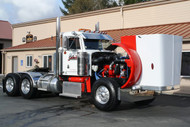
So You Have A "Donor Truck"
Posted by Kustom Truck Parts on 20th Nov 2025
The Truth About Using a Donor Truck for an Engine Swap in a Peterbilt or Kenworth
There’s one misconception we hear every single day:
“I bought a complete donor truck with the exact engine I want — engine, wiring, hoses, brackets, the works — so I’ve got everything I need to drop it straight into my newer truck.”
In reality, that only works in one very narrow case. Everything else is a headache waiting to happen.
What is a “donor truck”?
A donor truck is a complete, running (or recently running) truck you purchase primarily for its engine and whatever parts might come along with it. Most owners assume that because the engine is already installed and everything functions in that truck, all the “assembly parts” will transfer directly to the new chassis.
That assumption is only true in one scenario:
A true like-for-like swap
Example: You blow up the Detroit in your 1997 Peterbilt 379 and you find another 1997 Peterbilt 379 with the 3406E 1LW you’ve always wanted. Same year, same model, same hood length, same factory cooling package. In that rare case, yes — motor mounts, charge-air plumbing, coolant plumbing, intake piping, exhaust routing, fan hub, belt configuration, and most brackets are directly interchangeable.
That situation is the unicorn. It almost never happens.
The far more common scenario is taking a great-running pre-emission or early-emission engine out of an older truck and installing it into a 2010+ Peterbilt 389, Kenworth W900L, T680, T800, etc. That’s when the “I’ve got all the parts” myth collapses.
Let’s walk through the four critical areas (same categories from our Engine Conversion Basics blog) and explain exactly why donor-truck parts rarely work.
1. Electronic Interface – The Wiring Is Almost Never Reusable
Trucks evolved from simple analog dashes and mechanical engines to fully digital, multiplexed systems with multiple ECUs talking over CAN bus network.
- A 2006-vintage harness (even on the exact same engine family) will not interface into a 2016+ truck without major surgery — and in most cases, it simply can’t be done at all.
- Connectors changed, pin counts changed, data protocols changed, and the amount of information the ECM expects from the chassis increased dramatically.
Bottom line: Plan on a new engine-to-chassis interface harness. The donor wiring is usually scrap for anything other than a specific generation of chassis wiring.
2. Piping Kits & Cooling Package – Almost Nothing Lines Up
Cooling packages have been redesigned with every major emissions change (pre-EGR → EGR → DPF/SCR → X15 Efficiency, etc.). Radiator size, charge-air cooler size, and mounting locations all changed — multiple times.
- The charge-air pipes that bolt perfectly to a 1LW in a 1998 379 will not reach or align with the inlet/outlet orientation of the much larger radiator and charge-air cooler in a 2018+ 389.
- Turbo inlet and outlet diameters are engine-specific (example: CAT C15 = 6" inlet / 5" outlet; Cummins ISX CM2350 = 4" inlet / 4" outlet). Your old Cummins intake or exhaust piping is worthless on a CAT swap and vice versa.
- Twenty-year-old exhaust flex pipes, clamps, and elbows are usually rusted solid anyway.
Result: At best, the short engine-side stubs from the donor truck are correct. Everything else — from the cooling package to the turbo and from the turbo to the stacks or air cleaners — will be new or custom conversion piping. Count on it.
3. Brackets & Motor Mounts – Compatibility Is the Exception
Rear mounts are the biggest trap people fall into.
- Up through roughly 2011 (Kenworth) and 2012 (Peterbilt), both manufacturers used a traditional serviceable bushing-style rear mount with separate frame brackets.
- They then switched to a 2-bolt Trelleborg design that incorporated the bushing into the bracket.
- A few years later they moved to the current 4-bolt Trelleborg design.
The brackets bolted to the flywheel housing must match the style on the frame rails. A 2-bolt flywheel bracket will not bolt to 4-bolt frame mounts (and vice versa).
Front motor mounts also vary by make, model, and even hood length. The same Detroit Series 60, ISX, or C15 used completely different front cradle designs depending on whether it came in a Peterbilt, Kenworth, Freightliner, Western Star, or International.
Don’t forget the often-overlooked under-hood air cleaner brackets. If your donor had side-of-cab mounted external air cleaners, it has zero mounting brackets for the under-hood cans that a T800, T660, etc. expect.
4. Engine Upfit – The Engine Was Built for a Different Chassis
Cat, Cummins, and Detroit ship bare engines to the OEMs. Peterbilt, Kenworth, Freightliner, etc., are the ones who decide final accessory layout:
- Front motor mount style and design
- Fan hub height and belt routing
- Alternator and A/C compressor mounting
- Air compressor location and plumbing
- Oil pan sump location (front sump vs. rear sump)
- Thermostat housing orientation
- Exhaust manifold diameter
- Air inlet manifold connection
A 3406E 1LW or C15 with the exact same serial-number prefix will have a completely different accessory arrangement in a Peterbilt 379 than it did in a Freightliner Century Class — and both will be different again from what a newer 389 or W900 needs.
So Is a Donor Truck Ever Worth It?
Absolutely — it’s still the smartest, cheapest way to get a proven, matched-set engine with ECM, turbo, injectors, and fuel system already together. That alone can save you thousands versus piecing one together from scratch.
Just don’t budget or plan as if all the brackets, hoses, and wiring are coming with it.
In 95% of conversions into 2010+ trucks you will still need:
- New engine and chassis wiring harnesses
- New charge-air, coolant, and intake/exhaust piping
- New or compatible motor mounts (flywheel brackets must match frame style)
- New air cleaner brackets and intake piping
- Possibly a different fan hub, alternator bracket, A/C compressor location, oil pan, etc.
Treat everything beyond the long-block and major components as a bonus, not something you can count on.
Got a specific donor and recipient combination you’re looking at? Drop it in the comments or give us a call — we’ve supplied countless conversion kits for Peterbilt and Kenworth brand trucks and can tell you in about 30 seconds exactly what parts will transfer, need to be fabricated or modify to make it work and what you’ll have to buy new.
Ready to start your repower the right way?
Contact us for a complete, truck-specific conversion parts list. We stock everything you’ll actually need — harnesses, Trelleborg mount kits, custom piping, air cleaner brackets — so you’re not fighting 20-year-old parts into a modern chassis.
Ready to Repower Your Truck? Call Now: 1-888-564-8890
Mon–Fri 8AM–5PM PST | Speak with a repower specialist